
Robotic Spine Surgery in India
Compare hospitals, specialists and costs for robotic spine surgery — and get a personalised quote from Medworld India within 24–48 hours.
Overview
Robotic Spine Surgery
Today Robotic Surgery is revolutionizing modern healthcare by offering more precise, secure and minimally invasive to treat varied medical conditions. Now surgeons can easily operate complex procedures with the help of advanced robotic-assisted technology resulting in enhanced accuracy, smaller incisions, less pain, reduced blood loss and faster recovery for patients. India has come forth as a prominent destination for robotic surgery, bringing together it together with world class medicinal expertise and leading-edge technology at half the cost if compared to several other countries. Preeminent hospitals across India are equipped with state-of-art robotic surgical equipment’s and worked by highly experienced specialists in their respective fields such as oncology, cardiac surgery, urology, orthopaedics, ENT and gynaecology.
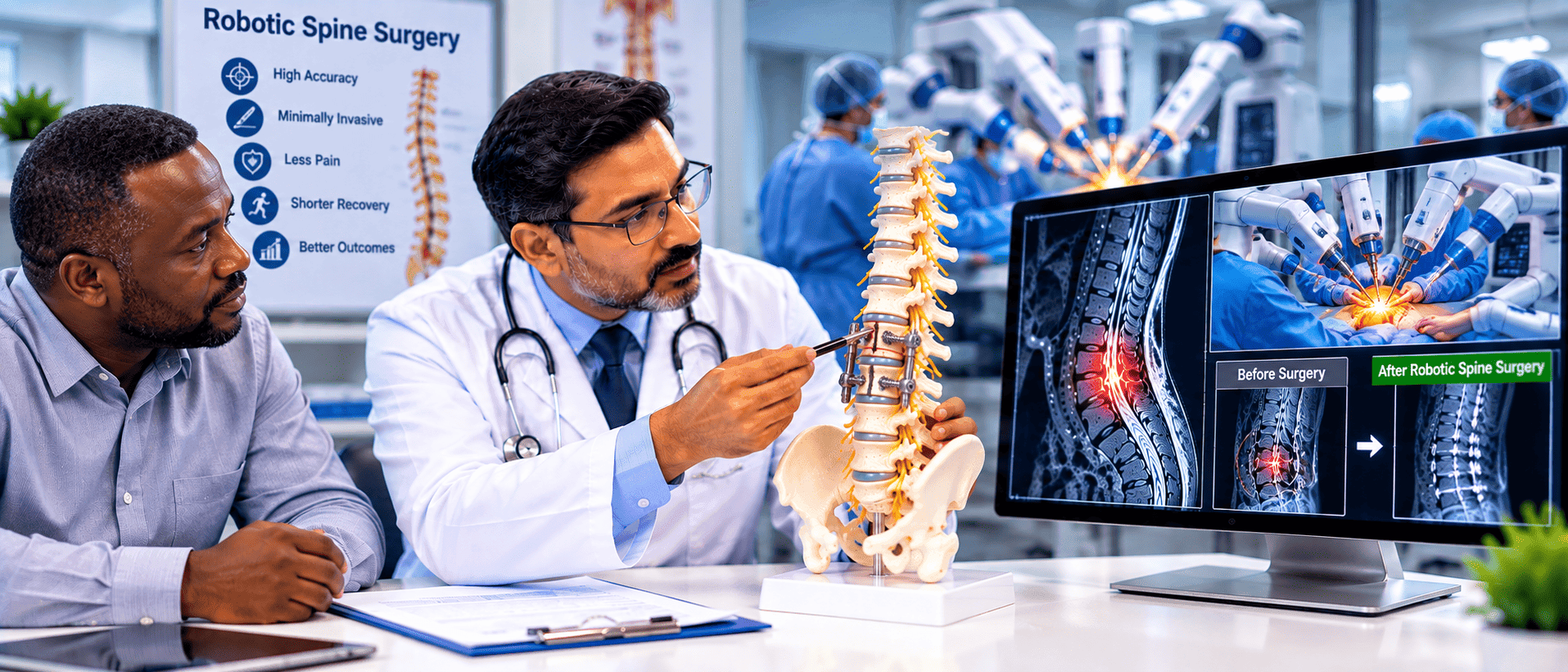
We at Medworld India aid international patients receive outstanding robotic surgery programs connecting them with prominent surgeons and accredited hospitals. From the day medical assessment is done to the day treatment planning is shares to visa assistance to travel coordination to accommodation and post-operative care; our devoted team makes sure patient have smooth and worry-free treatment journey. Whether you require robotic surgery for prostate disorders, kidney diseases, cancer, gynaecological circumstances, digestive disorders or any other complicated mechanism, we are here to help you obtain custom-made, quality care from leading robotic surgery experts available in India.
How Robotic Spine Surgery is Different From Traditional Spinal Surgery
Whether patient is going for open or minimally invasive robotic spine surgery, the aim to do these surgeries is to increase surgical accuracy and meticulousness, whilst lowering risk of worries and speediness in patient recovery. Chief differentiation between robotic and traditional spine surgery is the old procedure comprises surgeon engaging and treating the spine surgery with hands and instruments, whereas robotic spine surgery uses a robot under the direction of a surgeon to perform the procedure.
Common misconception about robotic spine surgery is that complete procedure is done by a robot, however this is inaccurate. A robotic arm can move by itself. A console is attached to robot’s equipment. The surgeon then supervises each and every movement of the robotic arm in the complete surgical procedure. As per research there are several benefits of robotic spine surgery are accomplished with minimally surgical methods and equipment’s. it is important to remember that prior and later all along the procedure the surgical robots used for spine injury completely rely on imaging and navigation.
The most compelling technology that is not dependent on robot is navigation. Contrariwise conventional surgeries have shown contrarily the level of precision, negligible openings, prevention of soft tissue, nominal blood loss, less operating times and lessened radiation contact.
Aim of Robotic Spine Surgery
In today’s time when technology is so advance robotic spine
surgery is avant-garde and favourable for individuals with stringent disorders
or disease in spine. Patients who are facing difficulty in leading a normal
life and performing their daily tasks are the ones who might be the one in need
of surgery.
In many cases when any physical therapy or medication is not beneficial, then surgery is the last resort. Conditions where surgical treatment is required:
Scoliosis
It is a muscular disorder linked to spine or nervous system is known as scoliosis. It generally affects the kids who are in between age 10 year and 14 years. There are several other reasons that effects the aggressive spinal curvature affects the spine.
Degenerative Disc Disease
Severe neck and back pain are caused by worsening of the spinal discs in spine. Furthermore, it can conclude in unbearable pain and numbness in arms and legs.
Herniated Disc
Herniation is a rupture of spinal disc that occurs again and again and is much like degenerative disc disease.
Kyphosis
This is a disorder that strike lumbar, upper back and cervical. Several types of complex deformity are also there which includes postural Kyphosis, Neuromuscular Kyphosis, Degenrative Kyphosis, Traumatic Kyphosis, Cogenital Kyphosis, Osteoporosis-related Kyphosis and a few others.
Spondylolisthesis
In this disorder the patient’s vertebra slides ahead into the bone below in this condition. It restricts the spinal cord or the nerve roots and generally the lower spine. Relentless back pain and weakness/numbness in legs are all because of spondylolisthesis.
Robotic Spine surgery is satisfactory treatment for all the conditions mentioned above, as it can assist patients in reconstructing patients’ quality of life. The most reasonably evaluated treatment option in India, is Robotic Spine Surgery. There are several other circumstances that are similar disorder where Robotic surgery is required such as:
- Coronary artery bypass
- Gallbladder removal
- Hip replacement
- Hysterectomy
- Kidney removal
- Mitral valve repair
- Pyeloplasty
- Pyloroplasty
- Radical prostatectomy
- Tubal ligation
It’s important to remember that not all spine surgeries need
Robotic surgery. All the possible risks and benefits are carefully evaluated
and then a surgeon can assist and conclude whether the patient’s health
condition need robotic surgery for treatment.
What Are The Benefits of Automated Spine Surgery
There are several benefits of Robotic Spine Surgery over the old Spine surgery method, and this is all because Robotic Spine Surgery handles the skills and abilities of the finest neurosurgeons in India. Robotic spine surgery improves the old and traditional spine surgery by waive out the human error. One should not overlook a few benefits of robotic spine surgery:
Upgraded Precision
Robotic surgery’s advancement is directed to promote precision and accuracy. The surgeon can easily execute the surgery with a level of meticulousness that can be challenging to achieve through traditional surgical methods.
Negligible Incisions
As compared to traditional spine surgery, the robotic spine surgery generally takes fewer incisions. This lessens the separation of muscle tissues and also reduces the possibility of any complications.
Shortened Span of Operating
If one compares the traditional free hand surgery to robotic surgery then they can experience 36% less time. Whereas traditional surgery takes 56% more time than robotic surgery (as per data)
Reduced Radiation Exposure
Traditional minimally invasive spine surgery often relies on fluoroscopy (real-time X-ray imaging) to guide the surgeon throughout the procedure.
Frequent use of fluoroscopy increases radiation exposure for both the surgeon and the operating room team.
Robotic-assisted spine surgery significantly reduces the dependence on continuous fluoroscopic imaging while providing a highly detailed, three-dimensional view of the surgical anatomy, helping minimize radiation exposure for everyone involved.
Reduced Radiation Exposure
- Traditional minimally invasive spine surgery often relies on fluoroscopy (real-time X-ray imaging) to guide the surgeon throughout the procedure.
- Frequent use of fluoroscopy increases radiation exposure for both the surgeon and the operating room team.
- Robotic-assisted spine surgery significantly reduces the dependence on continuous fluoroscopic imaging while providing a highly detailed, three-dimensional view of the surgical anatomy, helping minimize radiation exposure for everyone involved.
Faster Recovery and Quicker Return to Daily Life
- Robotic-assisted procedures require smaller incisions and cause less disruption to surrounding muscles and soft tissues.
- Reduced tissue trauma often results in:
- Less post-operative pain
- Reduced muscle damage
- Lower risk of muscle stiffness
- Faster wound healing
- As a result, many patients are able to regain mobility and return to their normal daily activities sooner compared to traditional open spine surgery.
Improved Surgical Precision and Reduced Risk of Complications
- Robotic technology provides surgeons with enhanced accuracy during complex spinal procedures.
- It enables more precise placement of spinal implants, such as pedicle screws, reducing the chances of implant misplacement and associated complications.
- Greater surgical precision can also help preserve healthy tissues and improve overall surgical outcomes.
- While many clinical studies report lower complication rates with robotic-assisted surgery, outcomes may vary depending on the specific procedure and the patient's condition.
Lower Need for Revision Surgery
- Revision surgery may be required if the initial operation does not achieve the desired outcome or if complications develop.
- Improved implant accuracy and surgical precision with robotic assistance can reduce the likelihood of needing additional corrective procedures.
- Several studies have reported significantly lower revision surgery rates for robotic-assisted spine procedures compared with conventional techniques.
- Avoiding revision surgery not only reduces physical and emotional stress for patients but also helps decrease healthcare costs and recovery time.
Specialists for robotic spine surgery
 DR. SANJAY SARUPHead – Othopaedics (Unit-II) and Chief-– Paediatric Orthopaedics & Spine Surgery
 Dr. Sandeep VaishyaEXECUTIVE DIRECTOR & HOD NEURO SURGERY
 Dr Anurag GuptaAssociate Director & Head of the Unit – Neurosurgery
 Dr. Puneet GirdharDirector & Head – Ortho Spine, Minimally Invasive & Robotic Spine Surgery
Get a personalised quote for robotic spine surgery
Share your reports — no cost, no obligation, reply within 24–48 hours.